Posts

Showing posts with the label Measurement

Capacity continued...

Image
After we went outside and actually measured liquid volume, we learned how to remember conversions.  There are many ways to do this...Of course you know about Gallon Man.  Have you seen Laura Candler's new Gallon Robot? This is a great new take on Gallon man.  I like how she breaks down cups into ounces as well.  She also includes several games, word problems and practice items using Gallon Man. We use gallon man in third grade and so we moved on to the Big G instead. I like this version for us in fourth grade ...it fits in nicely with our multiplication concepts as well as fractions.  It is also something that students can remember and reproduce on scratch paper for state testing.  They can draw this easily and then use this when they have problems with conversion on the test.  We took our measurement from yesterday and found out if our tubs held a gallon or not.  We were able to use our data to figure out conversions in a meaningful way. We also...
Introducing Capacity...

Image
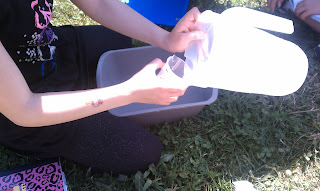
We started our capacity unit of measurement this week.  To introduce it, I had my students start with a problem.  How much water will our tubs hold?   I gave them a collection of quarts and cups for the students to use to fill up their tubs.  Because I really wanted the kids to experience filling up the tubs in small groups using "shocker" real water, I arranged to use our outdoor classroom spot.  That way, if water spilled - it was on the ground.  Before we went outside, we wrote our question in our science notebook and discussed the need for recording the data as we filled up the tub.  How would we record it? How would we keep track?  My students are comfortable working in their science groups where each one has a rotating job.  (Getter 1, Getter 2, Starter and Reporter)  They know by now how to work together and they do it very smoothly...Everyone is engaged...everyone shares the work. When we were finished we came in side and shared...

Measuring items in ounces...

Image
We have continued to explore measuring items in ounces by setting up stations outside our classroom. One of my colleagues suggested that we use a variety of scales for kids to use which I thought was a brillant idea!  We used an electrical scale, a FOSS balance scale with gram stackers and a really cool dual sided scale (it measures both ounces and grams).  We started with a question - Is the mass of smaller objects always less than larger objects? Our students then partnered up and went in search in organic objects/objects in nature.  We found rocks, sticks, leaves, mulch, etc....  We recorded our data on a chart in our notebook. Object ounces grams

Comparing pound and ounces

Image
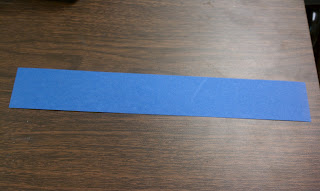
This is a great lesson that we found through one of our resources at school called Math Buddies.  It is a prepacked kit with manipulatives, games and lesson plans all packaged up together to use for tutoring or intervention groups.  Sometimes, we use activities from it for the whole class....like this Visual Model How much is a pound? Start off with a 8 X 2 inch paper strip. This represents a pound. Then fold it 1/2, then in 1/4, then in 1/8ths and finally in 1/16ths. Label each section -   oz.  And record in your science notebook!

How much IS a kilogram????

Image
So today, we moved from simple grams to an actual kilo-gram.  This is one of my favorite FOSS lessons because it is actually building a kilogram unit using rocks!  The students will work as a team to create 10 bags with 100 grams of rocks in each bag.  I have five science groups, therefore each team is responsible for creating two bags filled with 100 grams of rocks. As each team filled the bags with rocks, they were able to put gram stackers on the other side of the balance scale to equal 100 grams.  The kids really enjoyed this because they had to be precise in their measurements. Next, we put all ten bags together into one gallon sized bag. I also had a kilogram weight that we passed around so that the kids could feel the weight of a kg vs. the weight of a gram. It was a good connection to count each bag by 100's until we had all 10 bags which equaled 1,000.   I think having this visual model is important because mass is one of those units that can be hard to...

Measuring mass....

Image
Our measurement unit continues and this week we are on to mass.  We started with the gram unit and used our gram stackers to measure three small units - a wood chip, a washer and a tile.  At first, we felt the mass in our hands and tried to put them in order from heaviest to lightest.  This lesson comes from Measuring Matte r the newest FOSS kit. Then we actually weighed them and recorded the mass in our notebook. It's a simple way to start, but sometimes that is the best way to make sense of mass. You can see the set up of our science notebook really well in this entry: Focus Question: Data - trial one and trial two Conclusion Next, we were able to put the steps in order to show how to measure mass using a balance scale. I think these lessons are simple in nature and therefore make an impact on our students.  When you teach measurement, it is so easy to teach it through worksheets and center games.  Don't forget to actually get out there and measure real object...

How do you recognize parts of an inch?

Image
Here in Virginia our studnets need to know how to measure a picture to the nearest inch, 1/2 inch, 1/4 inch and 1/8 of an inch.  How do we teach it? Let me show you.... First we started by passing out inch rulers and drawing three inch lines.  Then we divided one line in half, one line in fourths and one line in eigths.  Then we colored each section to show size. It looked like this in their science notebooks. Part two - we went outside to our school garden in search of objects that were less than one inch.  The students had so much fun measuring objects in nature and recording them in their science notebooks. They found a ladybug that was about 1/8 of an inch. Here is a sample of the notebook entries from one child.... I don't know if you can read it, but it says A growing white flower (1/8 of an inch). A pebble (1/4) of an inch. The inside of a yellow flower (the stigma) 1/4 of an inch Ant = Half an inch 

Benchmark Meaurements for Length

Image
Like I've stated before, we jam too much information into our students heads...I think it is extremely valuable to teach our students how to measure in length, capacity and by mass.  However, do they really need to remember benchmarks for estimating and coversions between units???  Regardless, we teach it....so here is an idea my team came up with.  We decided to make a chart to show benchmark measurements for length...complete with visuals. Another thing we have to teach is how to convert within US Standard and within Metric as well as between the two.  One way to do this is also with an anchor chart to refer back to when you are really measuring items in the class room.   Here is a FREEBIE to record measurements of things in your classrooms in inches, yards and feet. Grab it here for free!

Measurement with meters

Image
Boy...are our standards confusing!  My team and I have spent quite a bit of time gathering activities that are hands-on, content rich and cover the standards for Virginia.  Are you as frustrated as we are about the multitude of measurement info that we bombard our students with?   We have been working on length and need our students to understand....Metric units (mm, cm, m and km) as well as their relationship to US Standard Units (1/2, 1/4, 1/8 of an inch, foot, yard, mile).  Phew it is confusing! This week we did several activities...including the setting the need for a standard with different sized straws as well as measuring things around the room with centimeters.  Both of these activities are from FOSS's Measurement kit and the new 3rd edition Measurement and Matter kit.   I love the meter stick that we make with this unit.  You can find it for FREE here ... along with all the other worksheets for the unit! The kids can each make their own ...