Posts

Showing posts with the label Hank

Steven Pinker's New Scientism

Image
Yesterday, The New Republic  published a big article by bestselling Harvard psychologist Steven Pinker . The title says it all: "Science Is Not Your Enemy." Or does it? After all: whose enemy is science supposed to be? Pinker's answer is there in his subtitle: the targets of his "impassioned plea" are "neglected novelists, embattled professors, and tenure-less historians." http://upload.wikimedia.org/wikipedia/commons/8/83/Steven_Pinker_2005.jpg Humanists: according to Pinker, science isn't your enemy—it's your friend. Or your extremely successful younger sibling. Its methods and results are yours if you want them—all you have to do is ask. The problem is: you don't  want them—you shy away from science, or reject it outright. Pinker's got a solution, and he's calling it "scientism." As Pinker points out, "scientism" is a term of abuse. It's usually hurled at "reductionist" efforts to pose scientifi...

Rule 14-1B: "Science" and "Tradition" in Golf

Image
Yesterday, the United States Golf Association (USGA) announced a rule change . Coming into effect in 2016, Rule 14-1B will prohibit the use of so-called "anchored strokes" in sanctioned play. Rather than try to describe what "anchoring" is, here's a helpful graphic provided by the USGA: Source: http://www.usga.org/uploadedImages/USGAHome/rules/UNDERSTANDING%20ANCHORED%20STROKES.jpg As a strategy for putting, "anchoring" has become increasingly popular—and controversial—over the last decade or so. According to ESPN , four out of the last six winners in major championships used "anchored strokes," a rate of success that has fueled speculation about what (if any) competitive advantage such a stroke might confer. I'm not a golf fan, and I don't have an opinion one way or the other. What I'm interested in is the way this issue has been both contested within the golf community and portrayed in the media. Specifically, I was struck by ho...

The High Quality Research Act and American Science

Image
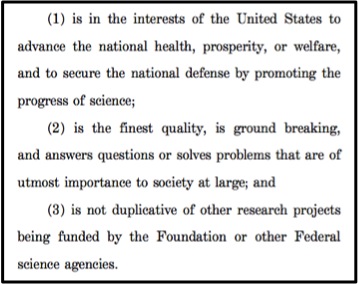
Yesterday, President Obama spoke at the National Academy of Sciences to mark its 150th anniversary. Alongside the usual issues, Obama took time to defend "the integrity of our scientific process" and "our rigorous peer review system."  Why? Because they're under attack—from within the halls of Congress.  Rep. Lamar Smith (R-TX) is preparing legislation that would disrupt peer review at the National Science Foundation (NSF). A draft of the bill—which is called the "High Quality Research Act" (HQRA)— leaked onto the web this week . It includes a new set of criteria for NSF projects: There are all sorts of reasons these developments should be of interest to readers of this blog—not least, the fact that the NSF funds the history of science through its Science, Technology, and Society (STS) Program . Below, I'll fill out a few of the details of what's happened, and suggest some ways HQRA (and its discontents) link up with issues of concern to scien...

The Science of Structure and the Apologetics of Agency

Image
What do Jonah Lehrer and Sheryl Sandberg have in common? I think it's productive to see their separate moments in the sun through a shared lens. The way they've been received recently tells us something interesting about the way ideas of structure and agency play out in the popular press, and specifically how science fits into that picture. Sources: http://www.thenextbigdesign.com/2011/12/brief-post-on-jonah-lehrer.html and http://www.newyorker.com/images/2011/07/11/p233/110711_r21057_p233.jpg In Lehrer's plagiarism and Sandberg's "Leaning In," critics have fixated on the relative emphasis the two give to structure and agency. Where Lehrer didn't take enough responsibility for his own agency, Sandberg made too much of hers (or any woman's), at the cost of structural inequalities. Below, I explore how (and why) the two account for structure and agency the way they do, with special emphasis on the role of science in their accounts. Let's start with L...

A Short History of Neuro-Everything

Image
Braaaaaaaaains are everywhere these days. In the wake of the big announcement about the  Brain Activity Map (BAM) Project , publicity around the mind sciences has been ramping up. This week is " Brain Awareness Week ," meant to raise public awareness about neuroscience. And today, Scientific American MIND announced a new homepage and blog network . A Portrait of the Author as a Brain Scan  All of this attention has produced some reflection. Patrick McCray has contextualized BAM in what he calls " the *-omics of everything ." He and others— including Gary Marcus —have highlighted the technological and methodological challenges such dynamic mapping faces, compared to the "static" maps of the Human Genome or Human Connectome Projects . What's interesting about all this is how ubiquitous the brain is already. As I noted recently , it's all over the academy: neuroaesthetics , neuropolitics , neuroeconomics , neurohistory —the list goes on. Pivoting aw...

A Novel History of Psychology

Image
BOOK REVIEW: Vanessa L. Ryan, Thinking Without Thinking in the Victorian Novel (Baltimore: Johns Hopkins University Press, 2012) ——————————————— Science and (the study of) literature are growing closer together. From  Stanford's Literary Lab  and a recent New York Times piece on the Digital Humanities  to reading Austen in an MRI machine  and so-called " Literary Darwinism ," there's both controversy and a certain cache (and maybe even a little cash) in bringing scientific techniques and the study of literature closer together. This is your brain on Austen ( http://news.stanford.edu/news/2012/september/images/mri_reading_news.jpg ) So what about the study of science and the study of literature? History of science, say, and literary history? The short answer is that it's happening in English departments, but not so much in History. Why? More on that below. Work on the interplay between science and literature has been dominated by scholars of the Victorian novel. G...

Advertising Psychology—or an Advertising Psychologist?

Image
A funny thing happened during the Super Bowl. No, not that thing . Yes, the 34-minute power outage brought a lot of issues into focus—issues linked to the "Sandy Studies" Lee proposed in the hurricane's wake ( and is now teaching ). But I have a different sense of power in mind—the power of (academic) science in the marketplace. On Sunday, Prudential aired a thirty-second spot (that could've cost up to $4,000,000! ) advertising its retirement planning services. The ad featured a "real-life experiment" (their term, from the video's description) emceed by a real-life academic scientist: social psychologist, bestselling author, and Harvard Professor Daniel T. Gilbert . Details of the proceedings are fleshed out in both the one-minute and behind-the-scenes expansions of the original spot. Some folks—though surprisingly few on Twitter , and comments are disabled for the video—might be curious why Gilbert got involved. This is certainly the first academic I...

Up Goer Five and the Rhetoric of Science

Image
Recently, the webcomic xkcd  spurred some discussion with a description of the Saturn V rocket that managed to use only the thousand (or "ten-hundred") most common English words. Entitled " Up Goer Five ," the strip provided a jargon-free explanation of rocket architecture and sparked a bit of reflection about the role of technical language in science and its wider dissemination. Detail from "Up Goer Five" (http://xkcd.com/1133/) In that sense, Up Goer Five is a bit like  #overlyhonestmethods , which I covered  here . Both highlight the possibilities (and pitfalls) of effective science communication, and both provide interesting opportunities for meditating on what role (if any) the social study of science might play in that process, and how such analysis fits with scientists' own public self-reflection. The phenomenon really took off with (1)  Theo Sanderson's web-based text editor  (that spell-checks every word you type against the ten-hundred co...

Science and its #overlyhonestmethods

Image
This week, a hashtag trended on Twitter that will be of particular interest to historians, sociologists, and other students of science: #overlyhonestmethods. One site has called it science's PostSecret ; 75 of the best examples have been curated at  Storif y. Here's what they look like: Frank, humorous admissions (or inventions?) of how protocols are cobbled together and assumptions are papered over, the #overlhonestmethods meme makes for great reading, especially for those of us interested in the gap between representation and reality in scientific practice and publishing. Bloggers at The Guardian , Scientific American , the Public Library of Science , and elsewhere have weighed in, most seeing #overlyhonestmethods as a refreshing peek inside the black box of science. Here, I'll inventory a few of the strands in the conversation, and offer some thoughts on what it all means. The Guardian 's headline captures what's at stake: "Scientists take to Twitter to rev...