Posts

Showing posts with the label Seeds of Science

Scale Models of the Solar System
Image
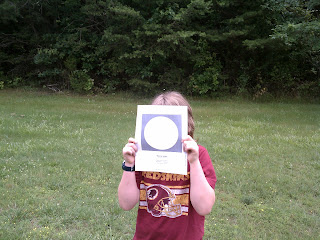
A few days back, I had a request to share with ya'll how I show scale models of the solar system.  Once again, Seeds of Science has an excellent model that I loved.  In the program, they have a printed sheet with the sun and the planets scaled down to be shown at 10 billion times smaller than the actual size.  (Imagine that!)   Unfortunately, it is copy written and I can not share it for free with you guys.  Sorry! However, I can tell you what we do....We went outside with a our picture cards. This is the sun.  I asked a student holding Mercury to go where he thinks he should be near the sun.  The students automatically thought they should be right on top of the sun. In truth, the student needed to be about 6 meters away from the sun.  Next, Venus was about 11 meters away from the sun.  Earth was 15 meters away from the sun and Mars was 23 meters away. Wow...the next planet is Jupiter and that is 50+meters away...too far away to show out...

Solar System

Image
  Do you teach the planets?  We have just added them back into our curriculum and I am so glad that we did!  We have spent the past two weeks learning about rotation and revolution of the earth and the moon.  We also talked about the surface of both areas...we were able to compare and contrast what they looked like and felt like.  The students quickly learned that even though there are rocks, mountains and valleys like Earth - without air and water, there is little chance for life.  Astronauts must wear special suits to exist on the moon for even a short period of time.  But what about the other planets?  We are using Seeds of Science's unit Planets and Moons which has a wonderful collection of planet trading cards.  If you do not have the kit, you can down load some from NASA here.   They are a lot larger than the ones that Seeds provides, but they do work. The kids spent the day reading and sorting the cards - first on their own, then ...

Earth Models

Image
We just started our last science unit of the year:  Planets and Moons by the Lawrence Hall of Science and Seeds of Science. In case you don't know, these science curriculum units are interdisciplinary - combining reading, writing and science to make a very full program.  I love them!  This unit starts by investigating models.   The first model the students investigate is the "Mt. Nose" model.  Using their head as a model of the Earth, they explore what happens to Mt. Nose when the sphere is rotating.  The students stand in a circle and face a light bulb (we use our lamp with out the lampshade).  As we rotate we notice that our mountain is in full sunlight, sunset, full darkness, and sunrise.  The students learn that rotating just means spinning. Next we introduce the model of an inflatable globe.  The students work to label four points across the earth (Hawaii, Thailand, Egypt and Florida).  Then we observe what happens when those mod...

AYP...feeling the pressure???

Image
As midyear assessments roll around, we have been talking a lot about math and reading.  Are we making growth? Yes!  Will they all pass the state assessment?  Hmmmm....In Virginia we are up to needed 90% of our students to pass the state assessments in math and reading in order to make AYP.  My school just had our annual review of our School Improvement Team and we realized that we need more time for intervention groups.  Should we take time away from social studies and science to ensure that they are ready to pass the tests??? This is a BIG QUESTION on a lot of teacher's minds.  No one wants to do this...but let's face it, many are. I want to share some knowledge that I have about why it is important NOT to take away science education.  Research at the Lawrence Hall of Science has shown an increase in reading scores for students using effective science programs - such as FOSS, Seeds of Science, or STC.  But my own research shows the same re...

Thinking about Humidity....

Image
Have I said lately how much I love Seeds of Science?   We have been exploring weather in our classroom using this module for weeks now.  One of my favorite investigations is exploring humidity.   We set up five stations with humidity strips to test for humidity in the air.  Humidity is the measure of water vapor and is a major indicator of precipitation and cloud coverage.  We place strips on the roof of a closed system with water in it... and with out water in the system.  If there is humidity in the air, the strips will turn pink or purple. Next, we put humidity strips on a tray and wave it with a cardboard fan.  A real fan works better, but I didn't have one available. We also put humidity strips on the closed system of a plastic bag - that the students breathe into.  Yes, water vapor from the students....cool! Our last investigation involves putting strips on a pencil that hangs over a cup of hot water that we have warmed in a kettle.  Th...

What's going on in my classroom now???

Image
We are working on WEATHER!  This is one of my favorite units because I use a unit from Seeds of Science called "Weather and Water".  This unit is so super cool because it takes children on an adventure through weather using excellent books as well as great hands-on experiences.   I can't give away all the "secrets"... I can only showcase a few moments from my classroom... One thing we do during this unit is observe water as it evaporates in the classroom.  Such an easy experiment to do - just set it up and watch the water disappear! We also keep track of the daily weather on a class chart and in our science notebooks. Another cool thing...we keep track of the clouds by making sky observations... Real photos help the children key in on the weather terms so that we can not only learn the scientific names of the clouds, but the types of weather that they create. And of course, DON'T FORGET THE WORD WALL...pocket charts are awesome! This is just a peek into my c...